

Thailand — Commodification of Prayer at the Erawan Shrine
The interplay between music, dance, and prayer constitutes a privileged field of observation for the anthropology of ritual practices, particularly in contexts where religious traditions intersect and evolve through contact with modernity. In Southeast Asia, these forms of sacred expression bear witness to the persistence of ancient symbolic systems inherited from cultural exchanges between India and the Indianized kingdoms of the region (Siam, Cambodia).
The Erawan Shrine, in the heart of Bangkok, offers an exemplary site for studying the continuity and contemporary transformations of votive dances. At the intersection of Brahmanic worship, Theravāda Buddhism, and the urban tourist economy, it stages a practice in which choreographic movement, song, and offerings merge into a single devotional act.
Photos, video: © Patrick Kersalé 2018-2026. Text: © Patrick Kersalé, Florence de Kervadec. Last updated: May 28, 2026.
For further reading…
Step-by-step video sequence
Location and date: Erawan Shrine. Bangkok. 2018.
Duration: 04:09. © Patrick Kersalé 2018-2026.
00:00 The Erawan Shrine is located at the base of the Grand Hyatt Erawan Hotel, at the intersection of Ratchaprasong and Ratchadamri Streets, in the Pathum Wan district. The elevated walkway of the BTS Chit Lom skytrain station overlooks it. The soundscape consists of automobile traffic noise, elevated trains, emergency vehicle sirens, and the performances of the piphat orchestra (ปี่พาทย์).
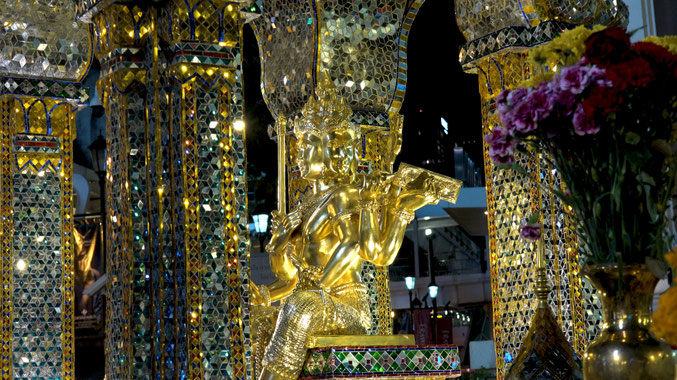
00:06 Another focal point of the shrine is a four-headed Brahma statue, one of the three deities of the Hindu Trimurti, gilded with gold leaf. On the left is the building where the dancers and musicians perform.
00:15 Devotees making wishes and offering flowers and incense sticks to the central deity.
00:25 Flower, incense, and votive object vendor. Prices are displayed in Thai baht (1US$ ≈ 33฿).
00:40 Vendor selling tickets for votive songs and dances. Depending on their financial means, devotees can choose between two and eight dancers for a price ranging from 270 to 710฿ (approximately 7 to 18 USD). The performance duration is fixed (45 to 55 seconds); the number of dancers hired determines the price. All information displayed in the shrine is written in Thai, English, and Chinese.
00:49 A shrine employee stores two elephants temporarily offered to the deity by devotees.
00:57 Devotees waiting for their turn.
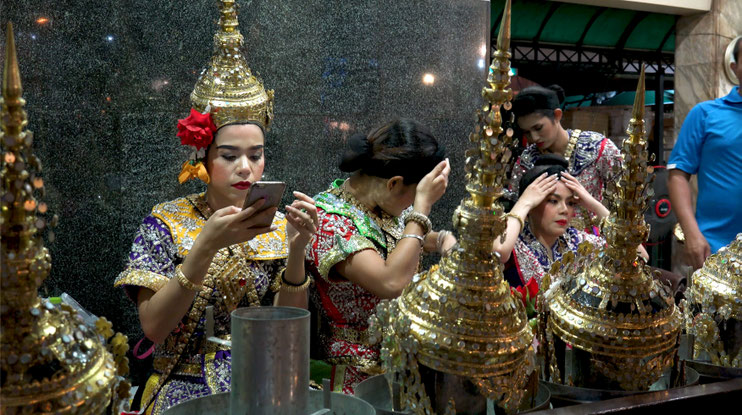
01:09 Supports for the dancers’ crowns and bags for transporting costumes and personal belongings.
01:12 The orchestra consists of three musicians. Instruments from left to right:
- This musician alternates between playing the “alto” bamboo xylophone, ranat thum ระนาดทุ้ม, and the Buddhist cymbals, ching ฉิ่ง.
- “Soprano” bamboo xylophone, ranat ek ระนาดเอก.
- Barrel drum, taphon ตะโพน.
01:32 Names of two devotees who purchased a performance.
01:34 A singer reads the prayer while being photographed from very close range by a devotee.
01:43 Devotees gathered around the Brahma statue.
01:48 Preparation and start of a new performance lasting about fifty seconds (real time with cutaways). Devotees remove their shoes or not, depending on their knowledge and respect for the practices. Meanwhile, one devotee applies holy water to their face. The dancers’ mudras have lost much of their grace and symbolic meaning in this commercial context.
02:39 Devotees surrounding the Brahma statue.
02:47 The musicians play like automatons while checking their smartphones. Note the offering of flowers and incense made to the taphon drum.
02:56 Donation Box. Container for monetary offerings with instructions in Thai, English, and Chinese.
03:03 A fourth musician playing the ching cymbals has joined the ensemble.
03:20 The dancers strike a pose after the line of waiting devotees has thinned out.
A practice rooted in ancient heritage
The Erawan Shrine, also known as the Thao Maha Phrom Shrine (ศาลท้าวมหาพรหม), is dedicated to the god Brahmā — or Mahābrahmā —, one of the principal deities of the Hindu Trimūrti. Although Thailand is predominantly Theravāda Buddhist, Hindu deities continue to be widely venerated there, as in neighboring Cambodia.
Singers-dancers perform daily votive songs and dances drawn from the traditional Thai repertoire: rabam thep bantheng, krailas samrerng, or putthanuparp. These performances are today one of the last permanent examples — in both Thailand and Cambodia — of a heritage of votive dances of Indian origin transmitted by the former courts of Southeast Asia.
Introduced into the Khmer Empire from the early centuries CE with the spread of Brahmanic influences, these practices later spread to the territories of present-day Thailand, particularly from the late 12th century onward. After the fall of Angkor in 1431, the Ayutthaya court continued their transmission and adaptation. This heritage has survived into the 21st century through the various court traditions of Siam and then contemporary Thailand.
The Erawan Shrine illustrates what Eric Hobsbawm and Terence Ranger have called the “invention of tradition.” The ancient symbolic structure — dance as a bodily offering addressed to the deity — remains, while its social, economic, and spatial context has undergone profound transformation. As Marshall Sahlins observed with the concept of “structures in history,” deep cultural schemas continue to be reactivated and updated in new historical contexts without losing their fundamental symbolic coherence.
The Erawan Shrine is located at the base of the Grand Hyatt Erawan Hotel, at the intersection of Ratchaprasong and Ratchadamri Avenues, in the Pathum Wan district, in the heart of Bangkok.
The ritual from the devotees’ point of view
Devotees, whether regular or occasional, come to pray before the gilded statue of Brahmā to offer prayers, offerings, and wishes. When their wishes are granted, they often return to the shrine to commission a votive dance (ram kae bon, รำแก้บน) as a sign of gratitude. Depending on the financial means of the sponsors, anywhere from two to eight dancers may be hired for a single performance.
This arrangement is generally not perceived as a vulgar commodification of the sacred, but rather as a pragmatic way of relating to the divine in a dense urban environment. Entrusting the performance to specialists ensures the proper execution of the ritual, which is essential to its symbolic efficacy.
The number of dancers plays a significant role: it does not merely reflect a difference in financial means, but publicly demonstrates the intensity of the devotee’s gratitude or debt to the deity. This echoes Marcel Mauss’s analyses of the gift: the offering is never a simple economic transaction, but part of a complex system of reciprocity involving obligations, recognition, and social relations. The shrine thus reveals a clear division of ritual functions: the devotee provides the intention, the promise, and the funding; the dancers provide the bodily and aesthetic expression of the relationship with the divine.
The ritual from the singers-dancers’ point of view

The singer-dancers can be either professionals of classical Thai dance or performers trained more quickly for the sanctuary's needs. They know a limited repertoire of songs and choreographic sequences. These positions are highly sought after due to their compensation, which is calculated based on the number of performances given. During peak periods, each of the two permanent troupes can perform up to two hundred sequences per day, with each group bringing together about a dozen performers.
The dancers occupy an ambivalent position, characteristic of contemporary ritual settings: they are simultaneously mediators of the sacred, guardians of a cultural heritage, and workers subject to intense physical demands and heavy economic pressures. Their bodies become the central medium of the ritual: gestures, postures, gazes, hand movements, and control of the ritualized smile form a codified body language transmitted from ancient Siamese traditions.
Marcel Mauss spoke of “techniques of the body,” while Thomas Csordas highlights the bodily dimension of ritual: song, posture, and movement merge into a single bodily offering addressed to Brahmā.
This organization also relies on a clear sexual division of labor: women occupy the visible space of sacred mediation (dance and song), while men are mostly associated with musical accompaniment or technical roles. This configuration contrasts sharply with major Theravāda Buddhist temples such as Wat Pho, where monks hold the institutional monopoly on ritual.
The work and its constraints
Although this activity is relatively well paid, it imposes particularly demanding working conditions. The dancers have very little rest time and often eat their meals between performances. The shrine, located in a very busy area of Bangkok dominated by hotels, shopping centers, car traffic, and the elevated train, continuously welcomes tourists, devotees, and photographers.
The performers thus work under constant visibility in a saturated sound environment where urban noise is an integral part of the ritual landscape.
This activity is part of a genuine ritual economy based on continuous bodily availability. The dancers do not merely produce an aesthetic performance: they maintain a permanent emotional and symbolic presence in a space saturated with religious, touristic, and commercial demands. The contrast is often striking between the traditional headdresses, sacred music, and gestures inherited from Siamese courts, and the smartphones, advertising screens, or tourists filming just a few meters from the altars.
The shrine thus reveals a progressive blurring of the boundaries between religious devotion, cultural heritage, public spectacle, and the tourist economy.
Critical perspective
Despite the professionalism of the performers, some performances show a decline in artistic standards: approximate synchronization of movements, sometimes reduced gestural precision, or musicians distracted by their cell phones.
This situation echoes the “routinization of charisma” described by Max Weber. The intensive repetition of performances, essential to the shrine’s economic continuity, gradually tends to standardize the ritual gesture. What was once a highly symbolically charged act can become a repetitive technical sequence subject to demands of productivity and visibility.
The image of musicians checking their phones is particularly telling: it materializes the coexistence of two temporal regimes — that of the sacred act, based on codified repetition, and that of contemporary hyper-connectivity, characterized by fragmented attention. Yet, despite this partial standardization, devotees continue to attribute full symbolic efficacy to the ritual. The religious experience does not disappear under the effect of the market economy; it transforms and reconfigures itself within its very constraints.
Conclusion
The Erawan Shrine bears witness to the persistence, in the heart of contemporary Bangkok, of an ancient form of religiosity in which song and dance remain inseparable from the act of prayer. The choreographic gesture constitutes a bodily offering on the same level as the sung word. Despite the constraints of repetitive work, tourist crowds, and the partial standardization of the ritual, these practices retain a surprising symbolic and devotional power. They offer a privileged vantage point for observing the contemporary recompositions of the religious sphere in a globalized urban environment.
This tension between preserved ritual efficacy and mechanical standardization is not unique to Erawan. It can be found in many professionalized rituals around the world — from mass pilgrimages to tourist-oriented cults — whenever the economic survival of a religious practice comes into conflict with its symbolic depth.
Yet this vitality raises essential questions: How far can religion adapt to market logics without becoming denatured? Does the Erawan Shrine represent a successful model of cultural recomposition, or is it an illustration of the gradual dilution of the sacred under the pressure of productivity and spectacularization? In the end, do ritual traditions truly survive thanks to their ability to adapt, or do they risk turning into performative simulacra? As contemporary religion recomposes itself at the heart of modernity, does it gain in resilience, or does it lose an irreducible part of its mystery?