Cambodia - Buong Suong, Danced Prayer and Ritual Act
The Buong Suong is a traditional form of ritual dance-prayer in Cambodia, where gesture, music, and ceremony come together to create a sacred language. Rooted in Khmer spiritual practices, this ritual seeks to establish a connection with invisible forces, protect the community, and accompany important moments of religious life. Through codified choreography and powerful symbolism, it embodies a worldview in which art and the sacred are inseparable, and where performance becomes both an act of devotion and a means of cultural transmission.
Texts, photographs, videos: © Patrick Kersalé 2017–2026. Last updated: May 28, 2026.
The Propitiatory Dance Buong Suong
The propitiatory dance Buong Suong (បួងសួង) occupies a singular place within the world of classical Khmer dance as embodied by the Royal Ballet of Cambodia. It does not belong to the realm of entertainment, but rather constitutes a ritual gesture addressed to invisible forces, ancestors, deities, and more broadly to the cosmic order that ensures the prosperity of the kingdom. Thus, referring to it as a “prayer in dance” is not merely metaphorical; it is an appropriate formulation to designate a religious act in which the body becomes a medium of intercession.
The term Buong Suong itself refers to the act of praying, supplicating, or paying homage. In its ritual usage, the dance seeks to obtain protection, peace, rain, agricultural fertility, and political stability. It is rooted in a conception of movement in which symbolic efficacy depends on the precision of gesture, the beauty of execution, and adherence to an inherited code.
A Court and Temple Tradition
Classical Khmer dance has been closely associated with the Cambodian court for more than a thousand years. It traditionally accompanied royal ceremonies, coronations, weddings, funerals, and festivals in the Khmer calendar. Until the Khmer Rouge revolution, a resident ballet at the Royal Palace in Phnom Penh served as one of its principal sites of preservation and transmission.
Its roots, however, are even older. As early as the seventh century, inscriptions mention dancers attached to temples, often in connection with funerary rites or offerings to deities. During the Angkorian period, dance formed part of a conception of power in which the king was the guarantor of cosmic order, agricultural fertility, and mediation between heaven and earth. Dancers were then regarded as the king’s emissaries to the gods and the ancestors.
Angkor and the Cosmic Function
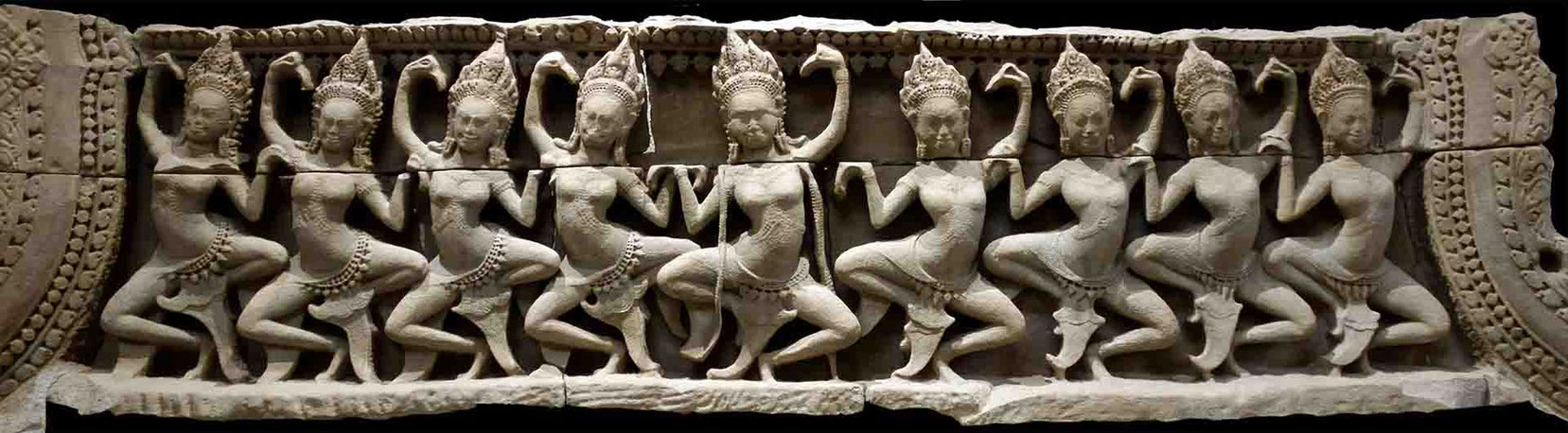
Under the Angkorian sovereigns, dance did not merely serve to embellish rituals; it contributed to the production of a symbolic order. Female figures, often identified with the apsaras and devatas sculpted on the bas-reliefs of Angkor, embodied celestial presences associated with prosperity, beauty, and fertility. This continuity between sculptural imagination, court ritual, and danced performance constitutes one of the most remarkable features of the Khmer tradition.
It is important to emphasize that Angkorian dance cannot be reduced to a decorative survival. It is a ritual technology, in the sense that it acts upon the world through gesture, rhythm, and address to invisible forces. In the Khmer agrarian context, this efficacy was conceived in particular in relation to rain, harvests, and the fertility of the soil.
On December 3, 2017, at the request of Prime Minister Hun Sen—then facing a period of heightened political tension following the dissolution of the main opposition party—more than 5,000 monks, dressed in their saffron robes, converged from across Cambodia to the temple of Angkor Wat. They took part in a large offering ceremony for the peace and stability of the kingdom. Within this exceptional context, the Royal Ballet of Cambodia performed the propitiatory dance Buong Suong (បួងសួង), thus offering a rare opportunity to observe this sacred piece in its authentic ritual setting, at the western entrance of Angkor Wat.
Buong Suong and Its Variants
Buong Suong appears as one of the oldest and most sacred forms in the classical repertoire. Certain versions, such as Buong Suong Tayay or Buong Suong Pream, are explicitly described as ritual prayers intended to protect the kingdom from misfortune, war, drought, and other forms of collective suffering. In these ceremonies, the dancers may symbolically “descend” from the heavens, scatter petals or cloths, and convey the supplications of the king and the people to the gods.
This dimension is also evident in contemporary contexts. Documented performances at Angkor Wat have shown that Buong Suong can still be mobilized to “re-sanctify” a place and to invoke prosperity for Cambodia. The significance of these present-day uses lies in the fact that they do not reduce the dance to a museum heritage; rather, they sustain its operative function as a ritual act.
The dance known as Robam Tep Monorom (របាំទេពមនោរម្យ) depicts gods and goddesses dancing in the heavens, adorned in their finest attire. The dancers’ costumes reflect those of Khmer royalty from the nineteenth and early twentieth centuries. Here, the Royal Ballet performs before delegates from various countries in the presence of His Majesty Norodom Sihamoni, on December 5, 2018, at the Terrace of the Elephants in the Angkor Archaeological Park.
Other Propitiatory Dances
Buong Suong is not an isolated case within the Khmer repertoire. Other forms share the same propitiatory logic and function of blessing. Robam Choun Por, for example, is traditionally performed as a blessing dance in which petals are scattered to bestow happiness and prosperity upon the audience. Robam Moni Mekhala, for its part, is associated with rain, the triumph of good over chaos, and cosmic regeneration. These dances belong to the same ritual economy: they petition, protect, give thanks, and restore harmony. One may also mention the pieces Robam Preah Thong Buong Suong (របាំព្រះថោងបួងសួង) and Robam Makar (របាំមករ) (see accompanying video).
Robam Preah Thong Buong Suong is a supplicatory dance that invokes the deities for peace, prosperity, and the protection of the kingdom, in connection with the founding myth of Preah Thong and Neang Neak.
Robam Makar represents the makara, a mythological aquatic creature symbolizing the forces of water and fertility.
Here, the Royal Ballet performs in the same setting as described previously.
The Syntax of Gesture
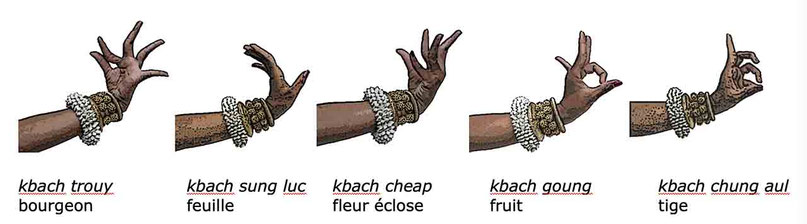
One of the essential points for understanding classical Khmer dance is that it possesses a structured bodily vocabulary, often referred to by the term kbach (ក្បាច់). Each hand position, each curvature of the arm, each orientation of the torso or the face carries specific meaning. A flexed hand may evoke a lotus; a circular movement may suggest rain or the cycle of life. Taken together, these gestures produce a coherent symbolic discourse.
One may therefore speak, without overstating the case, of a choreographic syntax. Here, syntax refers to the organization of gestures over time, their articulation with pin peat music, their movement through space, and the hierarchy of ritual moments. Dance is not a simple assemblage of poses; it arranges units of meaning into a form that is intelligible to practitioners and knowledgeable audiences.
This structure is crucial for understanding why the Khmer can conceive of these dances as genuine prayers. Where verbal prayer addresses words to invisible forces, danced prayer addresses gestures, rhythms, and orientations. The body thus becomes a liturgical language.
Body, Spirituality, and Mediation
The sacred dancers, long selected and trained with great rigor, were regarded as mediators between the human world and the divine realm. In traditional representations, they were seen as the messengers of kings to the gods and the ancestors. This function accounts for the sense of respect, discipline, and sacrality that surrounds the performance.
In certain ritual interpretations, Buong Suong could even extend to an idea of possession or temporary occupation of the body by spirits, thereby reinforcing the perceived efficacy of the prayer. Although contemporary forms are often situated within a broader heritage or artistic framework, the older logic of mediation remains perceptible. The dance is not merely a representation of the sacred; it is a means of access to the sacred.
Other Functions of Dance
However, reducing Khmer classical dance solely to its propitiatory functions would be incomplete. Its repertoire also includes narrative pieces based on the great Khmer epics, notably the Reamker, the Khmer version of the Ramayana. Certain works also fall under emotional expression, diplomatic celebration, or the staging of national identity. In all cases, the dance serves to manifest prestige, continuity, and memory.
Thus, the Royal Ballet has assumed several historical roles: religious, political, ceremonial, narrative, and identity-based. It is this versatility that explains both its centrality in Khmer culture and the intensity of the trauma caused by its destruction under the Khmer Rouge. The loss of most of the masters and dancers constituted not only an artistic loss but a rupture in the link between bodily memory and ritual transmission.
Disappearance and Revival
The Khmer Rouge period nearly caused the disappearance of Khmer classical dance. Most of the masters, musicians, and dancers were killed or scattered, brutally interrupting the chain of transmission. The revival began after 1979, thanks to the survivors who reconstructed the gestures, sequences, and repertoires from oral memory. The late Her Royal Highness Princess Norodom Buppha Devi devoted her life to this reconstruction—a reconstruction that started in refugee camps and within the diaspora, before being reestablished in Cambodia.
Today, the Royal Ballet is under the authority of the Ministry of Culture and Fine Arts of Cambodia, which ensures its preservation. But the tradition remains fragile, exposed to the constraints of funding, changing tastes, and the risk of tourist-driven folklorization. This is why the study of *Buong Suong* is not merely a matter of art history: it touches on the survival of a way of relating to the world.
Conclusion
Buong Suong thus appears as an exemplary form of danced prayer, at the crossroads of rite, power, and aesthetics. It belongs to a tradition where gestures constitute a language, where the syntax of the body produces an address to the divine, and where beauty is inseparable from symbolic efficacy. More broadly, it serves as a reminder that Khmer classical dance is not an art form detached from religion, but a practice that has long served to unite heaven, earth, and the kingdom.
From this perspective, dancing is not merely expressing a feeling or telling a story. It is to supplicate, to bless, to protect, to give thanks, and to reorder the world. Buong Suong remains, in this regard, one of the most eloquent formulations of what an embodied prayer can be.