
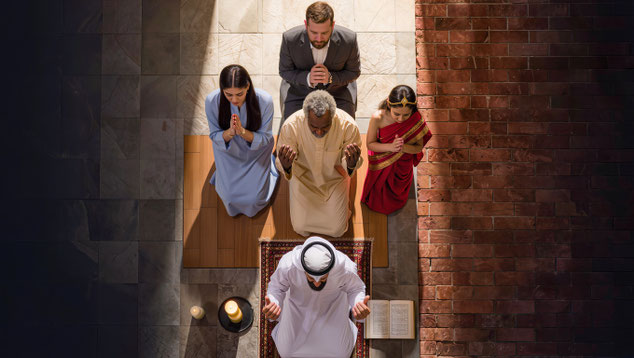
Prayer is one of the most universal expressions of the human experience of the sacred. Present in nearly all known cultures, it manifests in extremely diverse forms, ranging from silent interiority to complex ritual forms mobilizing the body, voice, music, and space. Despite this diversity, prayer can be defined, from an anthropological and religious perspective, as an intentional act of communication, relationship, or coming into presence with an entity perceived as transcendent, invisible, or supra-human.
Interiorized and Verbal Prayer
In its most interiorized form, silent prayer consists of mental activity without audible verbalization. It is often associated with meditation or contemplation, as in certain Christian traditions (mental prayer), Buddhist traditions, or Sufi traditions. This form primarily engages attention, affect, and concentration, and can be understood as an inner dialogue or a disposition toward listening. At the opposite end, spoken prayer involves explicit verbal formulation. It can be spontaneous or codified, individual or collective. Religious traditions have often produced corpora of fixed prayers — psalms (cf. the musical instruments in the Utrecht Psalter), mantras, invocations — whose repetition is believed to produce spiritual, psychological, or communal effects. Language plays a structuring role here, both performative and mnemonic.
The Musical Dimension of Prayer
Sung prayer constitutes an extension of speech into the musical realm. Singing, by modulating the voice, introduces an enhanced emotional and aesthetic dimension. In many traditions — Gregorian chant, Sufi qawwali, Hindu bhajan, and African ritual chants — melody participates in the symbolic efficacy of prayer. Instrumental accompaniment, when present, reinforces this dimension by creating a sonic environment conducive to trance, communion, or collective concentration.
The Body in Prayer: Dance and "Total Theater"
Certain forms of prayer also explicitly engage the body. Ritual dance, observed in many cultures (cf. Vietnam), can be understood as embodied prayer. It uses movement as a symbolic language addressed to the divine or to spirits. In Hindu traditions, for example, forms of "total theater" (cf. Bali) — combining music, song, dance, costumes, codified gestures (mudrā), and scenography — constitute fully-fledged devotional acts. These practices aim not only to represent the divine but to make it present, within a performative logic in which aesthetics and ritual are inseparable.
The Places of Prayer
From a spatial perspective, prayer is not limited to a single location. While many religions have instituted dedicated spaces — temples, churches, mosques — prayer can also be practiced in domestic settings, in personal spaces, or even out in nature. Animist traditions offer a particular insight here: prayer is often addressed to nature spirits (forests, rivers, mountains), but also to protective entities linked to objects or human constructions, such as dwellings, tools, or everyday items. This extension of the sacred realm reflects a conception of the world in which the invisible permeates the entire environment.
Antiquity and Anthropological Perspectives
Historically speaking, it is likely that prayer dates back to the earliest forms of symbolic thought in humanity. Although no direct evidence allows us to attest to prayer practices in the Paleolithic, certain archaeological clues — intentional burials, ritual objects, cave art — suggest the existence of behaviors related to beliefs in invisible realities. In this context, prayer may have emerged as an early modality of interaction with these presumed forces, situating human beings from the very beginning in a relationship beyond material immediacy.
Conclusion
Thus, prayer appears as a phenomenon that is both universal and polymorphic, revealing the multiple ways in which human societies conceive of and experience the relationship with the sacred. Whether silent or spectacular, individual or collective, it always engages a fundamental relational dimension, at the crossroads of language, the body, emotion, and culture.
Écrire commentaire