

Prayer in the Paleolithic Era
When does prayer begin? The question seems simple, almost intuitive. Yet, as soon as we go back to the Paleolithic, it becomes difficult — even impossible — to answer with certainty.
Prayer is an immaterial act based on speech, gesture, and inner intention. However, prehistory only preserves material traces: objects, bones, and physical arrangements. No scientific method, in the formal sense, allows us to hear spoken words or directly grasp an invocation. There is therefore no direct evidence of prayer for prehistoric periods.
What we can study, however, are the behaviors that suggest the existence of a symbolic and spiritual life. In other words, not prayer itself, but the conditions that may have made it possible — and even probable.
Text: © Patrick Kersalé, Florence de Kervadec 2026. Last updated: May 10, 2026.
The first significant traces appear with intentional burials around 100,000 years ago, among both Neanderthals (Homo neanderthalensis) and early Homo sapiens. Bodies were buried in an organized manner, sometimes placed in specific positions, accompanied by objects, covered with red ochre, and arranged with care. These gestures reveal a particular attention paid to the deceased: death was no longer merely a biological fact, but an event imbued with meaning. This implies a form of representation of the world, perhaps the idea of an existence beyond death or, at the very least, the establishment of a lasting relationship with the departed.
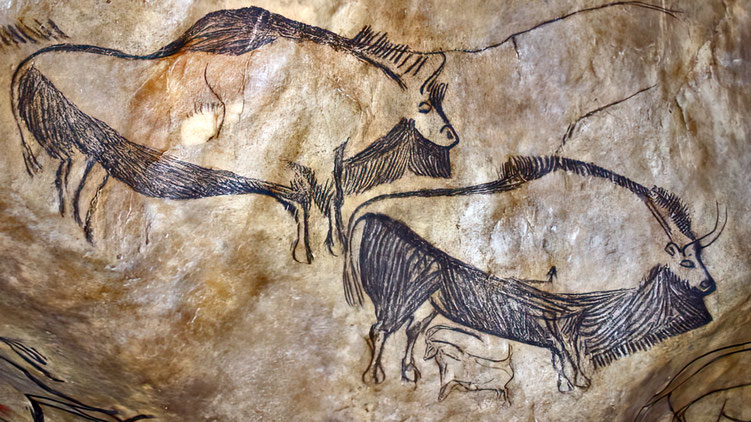
Tens of thousands of years later, humans left other clues of a sophisticated symbolic thought: cave paintings and engravings. In caves that are sometimes deep and difficult to access, we find representations of animals, abstract signs, hybrid figures, and handprints. These images go beyond simple aesthetic or decorative needs. Their location, often far from daily living areas, suggests specific, possibly ritual practices. In this context, it is entirely plausible that these activities were accompanied by gestures, music, chants, or forms of expression addressed to invisible forces. A combination of sensory experiences, engaging the body, space, and perception, can be compared to the concept of total polysensory — even extrasensory — theatre.
Other practices further strengthen the idea of a symbolic universe under construction: isolated and manipulated skulls, human remains treated in differentiated ways, objects repeatedly deposited in specific locations, perfectly shaped bifaces with no trace of use, overly large and fragile blades unsuitable for utilitarian work, elaborate funerary ornaments, and animals that were not consumed or were placed in fissures. These behaviors reflect a complex relationship with the dead, often interpreted as a form of remembrance or connection with ancestors, but also with animal spirits.
An important remark must be made here. The absence of direct evidence is not evidence of absence. Neanderthal anatomy shows that they possessed the anatomical prerequisites for articulated speech. Moreover, studies in cognitive psychology indicate that certain rituals create ideal conditions (repetition, stability, social pressure, fixed context) for language to become fixed into stereotyped formulas. This is not a flaw of the brain, but rather an optimization: it transforms frequent sequences into rapid, reliable, and energy-efficient automatisms.
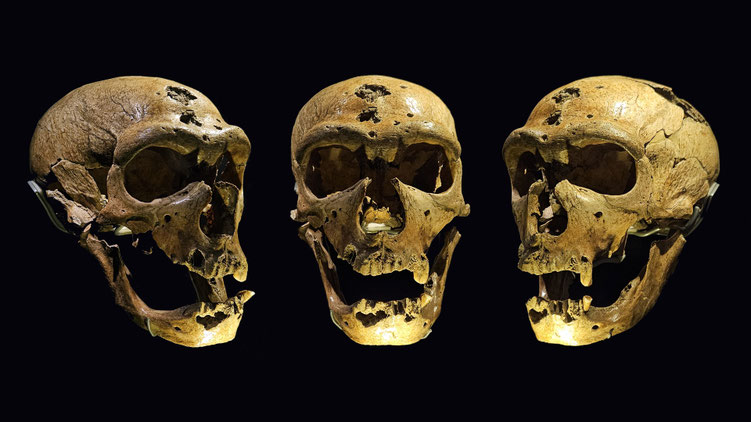
If the brain of a Homo sapiens from the 19th century is identical to that of our ancestors 100,000 years ago, and if rituals, through their repetition and structure, favor the emergence of stabilized verbal forms, the question of language nevertheless remains delicate. The presence of anatomical capacities compatible with speech does not guarantee the existence of articulated language as we know it today. It makes its appearance possible, without allowing us to confirm its reality. A ritual speech very likely existed.
The term “Paleolithic” itself deserves clarification. It refers primarily to a technology — that of knapped stone — rather than to a homogeneous period in terms of lifestyles or representations. While this classification is useful, it can give the impression of a bygone world. Yet certain hunter-gatherer societies studied by ethnography show comparable forms of experience and thought that persisted into relatively recent times. This invites us to view the Paleolithic not only as a stage of the past, but as a lasting mode of relationship with the world, without abandoning the chronological framework that structures archaeological analysis.
A particularly illuminating criterion for identifying ritual is the economy of the gesture or sign: the cost in time, energy, and resources. An object that is very costly to produce and deposited with no obvious practical use most likely signals a symbolic or spiritual function — an offering, a dedication, or even a prayer addressed to ancestors or spirits. Similarly, repetition, invariance of gestures, lack of obvious technical utility, the choice of spaces separated from daily living areas, or disproportionate effort are cumulative indicators that, while not decisive individually, allow us to distinguish ritual from the everyday with a reasonable margin of uncertainty.
The shamanic hypothesis, although not consensual, also deserves to be mentioned. Deep caves, plunged into darkness, could have served as places of trance, in contact with the spirit world. The paintings, associated gestures, sound objects (flutes, bullroarers, scrapers), and certain arrangements (isolated hearths, dark spaces) may have favored altered states of consciousness — a conducive framework for intense spiritual experiences, invocations, or forms of prayer addressed to animal spirits.

Thus, prehistory does not deliver prayer itself to us. It remains silent, mute in the traces that time has chosen to leave behind. Yet it reveals the essential: long before the first temples, long before sacred scriptures, human beings had already crossed a decisive threshold. They had begun to look beyond the visible, to direct their minds toward the invisible, to transform death into mystery and the world into an interlocutor.
Among these Paleolithic hunter-gatherers, whose cognitive capacities were comparable to our own, prayer may have constituted, among other forms of symbolic expression, a way of being in the world. A natural modus vivendi, a permanent dialogue woven between everyday gestures and the sacred dimension.
In the darkness of deep caves, facing walls animated with animal figures, practices blending gestures, sounds, and forms of address may have developed. A form of prayer, perhaps — silent to us, but vibrant for Paleolithic humans. For wherever the symbol is born, wherever ritual emerges, wherever effort is stripped of all utilitarian purpose, prayer becomes possible — not as a certainty, but as one of the oldest possible responses to the enigma of human existence.
The Neolithic period provides a complementary perspective. Sites such as Göbekli Tepe reveal the existence of monumental structures dedicated to ritual gatherings, in the absence of traces of permanent habitation. Here, ritual is no longer merely inferred from scattered clues: it asserts itself as a structured collective organization. It takes shape in space, is inscribed in stone, and becomes a shared reality rather than a reconstructed hypothesis.
Although later than the Paleolithic, these contexts demonstrate how far ritual practices can develop when social and symbolic conditions are aligned. In such a framework, it seems highly unlikely that collective forms could emerge without expressions directed toward invisible entities. At this level of structuring, ritual almost naturally called for speech, and with it, a form of invocation. While not constituting proof for earlier periods, this evidence nonetheless strengthens the hypothesis that forms of prayer may have emerged in ritual contexts as early as prehistory (Paleolithic).