

The World of the Invisible and Its Language
Speaking of prayer, spirit, guidance, or the divine means confronting the fundamental fragility of language. We believe we are sharing the same reality, but each of us carries words deeply marked by our own cultural history, collective psychology, and linguistic universe. The role of language is central: it does not merely 'name' the invisible—it orients and structures what we perceive of it, and sometimes distorts it. It is a tool for constructing reality, insofar as one can say so, as much as a lens that distorts it.
AI images. Text: © Florence de Kervadec, 2026. Last updated: June 2, 2026.
Reading further…
Lexical Variations: Language as Filter and Architect

Language is an active filter. It does not passively describe the invisible but conditions access to it according to specific cultural grammars. Words direct attention, organize reality within the limits of our symbolic tools, and make certain experiences conceivable while rendering others nearly impossible to formulate. Each term carries a different cultural, historical, and affective charge depending on the interlocutors.
Some spiritual narratives more closely resemble tales; others take on a poetic or philosophical dimension, while certain religious texts function primarily as moral frameworks or social codes. Not all, therefore, mobilize language in the same way or with the same functions. What is for one person an inner evidence becomes for another superstition, metaphor, or philosophical hypothesis.
In some monotheistic traditions, prayer involves a structured relationship with an identified transcendence. In contrast, several contemplative traditions of East Asia emphasize work on attention or the dissolution of the ego. Finally, in many animistic cosmologies, praying can mean entering a network of relationships with ancestors, places, animals, or natural forces.
Even the names for the divine—God, Allah, Brahman, the Tao—are never simple linguistic equivalents. Each carries an implicit cosmology, a particular way of thinking about time, the relationship to the world, the individual, or nature.
The word 'spirit' follows the same polysemous logic. It can refer to an immaterial substance separate from the body, a vital breath, a quality of presence, an emergent consciousness, or simply a psychological phenomenon, depending on the philosophical, religious, or scientific tradition.
Spiritual vocabulary also relies heavily on spatial and relational metaphors: 'rising toward,' 'being guided,' 'listening to the inner voice,' 'entering into communion,' 'receiving an illumination.' These expressions seem natural to those who use them, but they already shape the way the experience is lived and interpreted. They are rooted in deeply embodied schemas—the verticality of the body, breath, light, orientation in space—through which cultures make certain experiences tangible and shareable.
As Claude Lévi-Strauss observed in The Savage Mind, 'myth (and by extension any discourse on the invisible) is language, but language that works at a very high level, where meaning manages, so to speak, to take off from the linguistic foundation on which it first began to roll.'
Language therefore not only names the invisible: it shapes its symbolic architecture, through which societies organize their emotions, their beliefs, their intimate experiences, and their relationship to reality. No word, however, fully coincides with lived experience. This constitutive gap signals a remainder that language cannot exhaust.
This creative power of language has a fundamental limit: no word fully coincides with lived experience. This gap is not simply a flaw of language but may be the mark of a residue that language cannot exhaust. Every translation of the invisible remains partial, fragile, and culturally situated. This is why the same experiences—silence, presence, intuition, ecstasy, meditation, prayer, communion, dissolution of the self—can receive radically different interpretations depending on the symbolic frameworks within which they take on meaning.
Science and the Invisible: Fascination and Vigilance

Quantum mechanics holds a unique place in contemporary discussions of the invisible. Notions such as entanglement, superposition of states, non-locality, or Heisenberg's indeterminacy principle may seem to resonate with certain ancient mystical intuitions: the hidden unity of reality, the interdependence of beings, or the fundamental limits of human observation.
This proximity of vocabulary partly explains why many contemporary spiritual discourses draw on quantum mechanics in an attempt to reconcile science, consciousness, and transcendence. Terms like 'energy,' 'vibration,' 'frequency,' 'field,' or 'dimensions' now circulate far beyond their original scientific framework and become powerful cultural metaphors used to speak of emotions, presence, inner transformation, or connection to the world. The idea of a universe less mechanical and less predictable than classical physics once assumed has profoundly shaped the modern collective imagination.
Many physicists thus warn against the abusive use of quantum vocabulary in esoteric or pseudo-scientific discourses. Using terms such as 'energy,' 'vibration,' or 'frequency' outside their theoretical framework can create an illusion of scientificity without any genuine experimental content.
These parallels must therefore be approached with caution. Within the scientific community, attempts to directly link quantum phenomena and consciousness remain highly speculative and widely debated. The Orch-OR hypothesis (Orchestrated Objective Reduction), which proposes that certain quantum processes participate in the emergence of consciousness, remains highly controversial. The brain appears to be too hot, too wet, and too unstable to sustain coherent quantum states over time: this is the problem of quantum decoherence.
Quantum phenomena observed at the microscopic scale do not, in any case, constitute scientific proof of the existence of an 'invisible world.' A common confusion involves interpreting the quantum 'observer' as a human consciousness creating reality, when it is simply a measurable physical interaction.
The question of subjective consciousness, nevertheless, remains largely open. What philosopher David Chalmers has called the 'hard problem of consciousness' precisely designates this difficulty: even if neuroscience describes the neural correlates of consciousness, the mechanisms of attention, perception, or sensory integration better and better, it struggles to fully explain why and how physical processes give rise to an inner, qualitative, subjective lived experience.
For example, science can measure the wavelengths corresponding to the color red and observe the brain areas activated when an individual sees this color. But it cannot verify whether two people inwardly experience red in exactly the same way.
Yet we use the same words—pain, presence, love, silence, prayer—without being able to fully verify that the inner experience associated with these terms is identical from one individual to another. Language enables the sharing of the world, but never complete access to another person's lived experience.
Social and Political Stakes
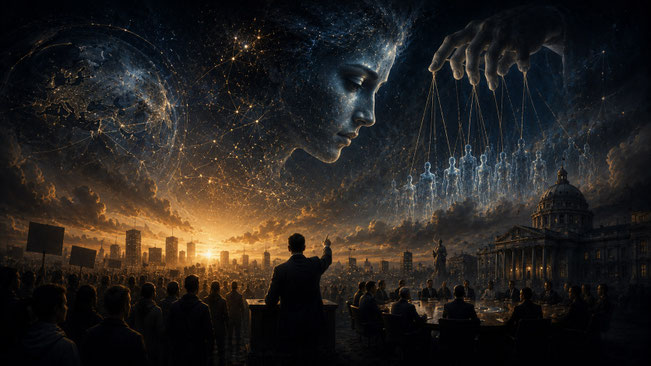
Here is the American English translation of your text, with title capitalization as requested:
"These linguistic and cultural differences are not mere intellectual curiosities. They deeply shape our societies, our collective sensibilities, our individual psychologists, and our ways of living together.
Monotheistic traditions have promoted a linear vision of time, a strong individual responsibility, and the idea of an inalienable dignity of the person.
Conversely, many relational or animistic cosmologies view the human being as embedded within a broader network of interdependencies with the living, ancestors, places, or natural forces, sometimes fostering less dualistic relationships between nature and culture.
Jean Malaurie, in his experience with the Inuit of Thule (The Last Kings of Thule), emphasized the depth of this animistic thought: it involves a 'savage prescience,' an ability to directly feel the 'creative energy' present in nature and beings, long before any abstract conceptualization.
Certain Buddhist currents have profoundly influenced conceptions of impermanence, compassion, mindfulness, or detachment, leaving lasting marks on social, aesthetic, and psychological practices.
But these symbolic systems can also become sources of tension or conflict when their categories are absolutized. When one tradition elevates its own grammar of the sacred to the rank of universal truth, differences in language and representation can transform into violent political, religious, or identity-based oppositions: crusades, wars of religion, spiritual colonizations, contemporary clashes over blasphemy, secularism, or cultural identity.
Notions such as 'submission,' 'idolatry,' 'purity,' 'truth,' or 'blasphemy' change profoundly in meaning depending on historical and cultural contexts. Yet, when they are perceived as absolute certainties, they can justify exclusion, domination, or violence.
In some highly secularized contemporary societies, the systematic reduction of spiritual experiences to mere neurobiological illusions, cognitive biases, or evolutionary leftovers can produce another form of symbolic impoverishment. Many people today express a lack of ritual, community, existential depth, or a relationship with mystery.
Conversely, absolute cultural relativism (where all beliefs are considered equally valid indiscriminately) can dissolve any possibility of critical thought and make genuinely rigorous dialogue impossible.
These tensions directly affect our way of inhabiting the world, of facing suffering, death, the ecological crisis, or the quest for meaning in increasingly technical and materialist societies.
The Fruitful Path: Lucid Humility

True progress undoubtedly requires an ethnolinguistic, cultural, and epistemological humility in the face of the power and limits of language:
Recognize that our words are partial, historically and culturally constructed, and sometimes deeply biased. They allow us to speak, but also to remain silent; they illuminate certain aspects of experience while leaving others in the shadows.
- Practice a perpetual translation between different symbolic frameworks without seeking to annex the other's experience to one's own grammar. This translation is never perfect, but it is the only path toward a dialogue that is neither a war of words nor a soft relativism.
- Accept that agreement on certain effects (calming, inner transformation, collective cohesion, feelings of presence or connection) may exist without agreement on their ultimate causes. This is a form of pragmatic peace: sharing fruits without requiring the same roots.
- Understand that humans always live within symbolic systems structured by narratives, images, categories, and metaphors. No one entirely escapes them, not even the most materialist scientist, for their own belief in a mystery-free reality is also a narrative, however evidence-based it may be.
As Ernst Cassirer reminded us, 'We are thus symbolic animals who can access the real only through the networks of meaning that are languages, myths, and rituals.' But between the sayable and the unsayable—a tension that Ludwig Wittgenstein so keenly perceived when he wrote, 'Whereof one cannot speak, thereof one must be silent'—is often born what is most alive in human experience. This tension is not a flaw to be solved, but a condition to be inhabited.
Conclusion
The invisible will likely remain largely a matter of vocabulary, not because it is illusory, but because our language, powerful as it may be in shaping our relationship to the world, always remains insufficient to fully exhaust it. There will always be a remainder, an excess that words cannot capture, that our symbolization cannot grasp.
Scientific words and religious words are never neutral labels: they open up worlds, organize sensibilities, hierarchize experiences, and make certain forms of reality thinkable while obscuring others. Quantum physics itself, in its mathematical language, is a form of translation of the real—powerful but never exhaustive.
Wisdom, perhaps, consists then in listening to the other's experience through their own grammar, without immediately reducing it to our familiar categories, while maintaining a critical mind and intellectual vigilance. It is neither a matter of accepting any belief for fear of judging, nor of rejecting any different belief out of attachment to one's own certainties.
Dialogue does not necessarily aim for uniformity of beliefs, but for the possibility of a human encounter within the very differences of our language, perception, and imagination. To encounter the other is not to absorb them into one's own language; it is to learn to hear what their language says that our own cannot say.
And perhaps the invisible resides not only in what we believe we see beyond the material world, but also in that irreducible part of human experience that words constantly try to grasp without ever fully succeeding in containing it. This part is not a mystery to be solved, but an invitation to humility and curiosity. It is what makes language alive, because it always stumbles against something that transcends it, and it is in this very failure that it finds its fecundity.