

The Mourners in Ramose’s Tomb
In ancient Egypt, mourners held a prominent place within funeral rituals, fulfilling a dual function: they embodied the grief of the deceased's relatives while also lending a solemn and dramatic dimension to the burial ceremonies.
The tomb of Ramose, a vizier from the 18th Dynasty, offers a remarkable illustration of this practice. Pictorial depictions reveal a meticulous organization of the mourners, divided into two distinct groups: one dedicated to lamentations and weeping, the other to the declamation or chanting of funeral elegies. This funerary staging, characterized by heightened expressiveness in both gesture and sound, held a significance that went beyond mere displays of mourning. Indeed, this ostentatious demonstration also aimed to attract the attention of benevolent spiritual entities. In the Egyptian conception of the afterlife, such ritualized expressions were perceived as a means of facilitating the deceased’s journey to the world of the dead. This transition — an object of both fear and hope for the living at the time —represented the ultimate aspiration of earthly existence within the religious thought of ancient Egypt.
Texts, photos, videos © Patrick Kersalé 2022-2026. Last updated: May 10, 2026.
General information
Mourners, or more rarely male mourners, are people hired to feign grief at funerals in order to make the tribute to the deceased more lavish. Although they are called mourners, they do not only weep. They are also capable of declaiming or singing lamentations. These actors sometimes substitute for people whose social status does not allow the expression of this type of emotion, as in Rajasthan (India). Mourners are attested as early as Antiquity in Mesopotamia, Egypt, and in biblical texts. Their service persists in certain cultures in the 21st century, particularly in Africa and Asia. In Cambodia, sound tools were invented long ago to replace mourners.
The ins and outs of weeping and lamentation share many similarities and points of convergence, apart from various local particularities: concealment within the crowd and collective sharing of individual grief, collective tribute to the deceased in a theatrical form, perpetual renewal of the acceptance of collective mourning process rules…
The number and quality of professional actors (earning their living from this activity) or semi-professional actors (dividing their time among various income-generating activities) indicate the social status of the deceased. Their number varies, depending on the culture, wealth, and available participants, from one to N.
There are two main typologies of funeral rituals. The first, theatricalized, involves physical engagement from the participating community; one can see and hear moans, cries, weeping, expansive gestural displays, songs, etc. The other, calmer, involves postures of dejection, restrained sadness, silent or expressed.
Mourners in funeral rituals
There have existed, since the earliest Egyptian antiquity, and still exist today, mourners in funeral rituals, particularly in Africa and Asia. Some are part of the family or village circle, while others are paid professionals. You are about to discover one of the most beautiful depictions of mourners from Egyptian antiquity, those from the tomb of Ramose, a vizier from the 18th Dynasty at the turn of the reigns of the pharaohs Amenhotep III and Amenhotep IV, also known as Akhenaten. The tomb is located at the foot of the hill of Sheikh Abd el-Gournah in Thebes.
In most tombs of ancient Egypt, the iconography of mourners is minimal. In the New Kingdom, one can see women of all ages, young girls, and children.
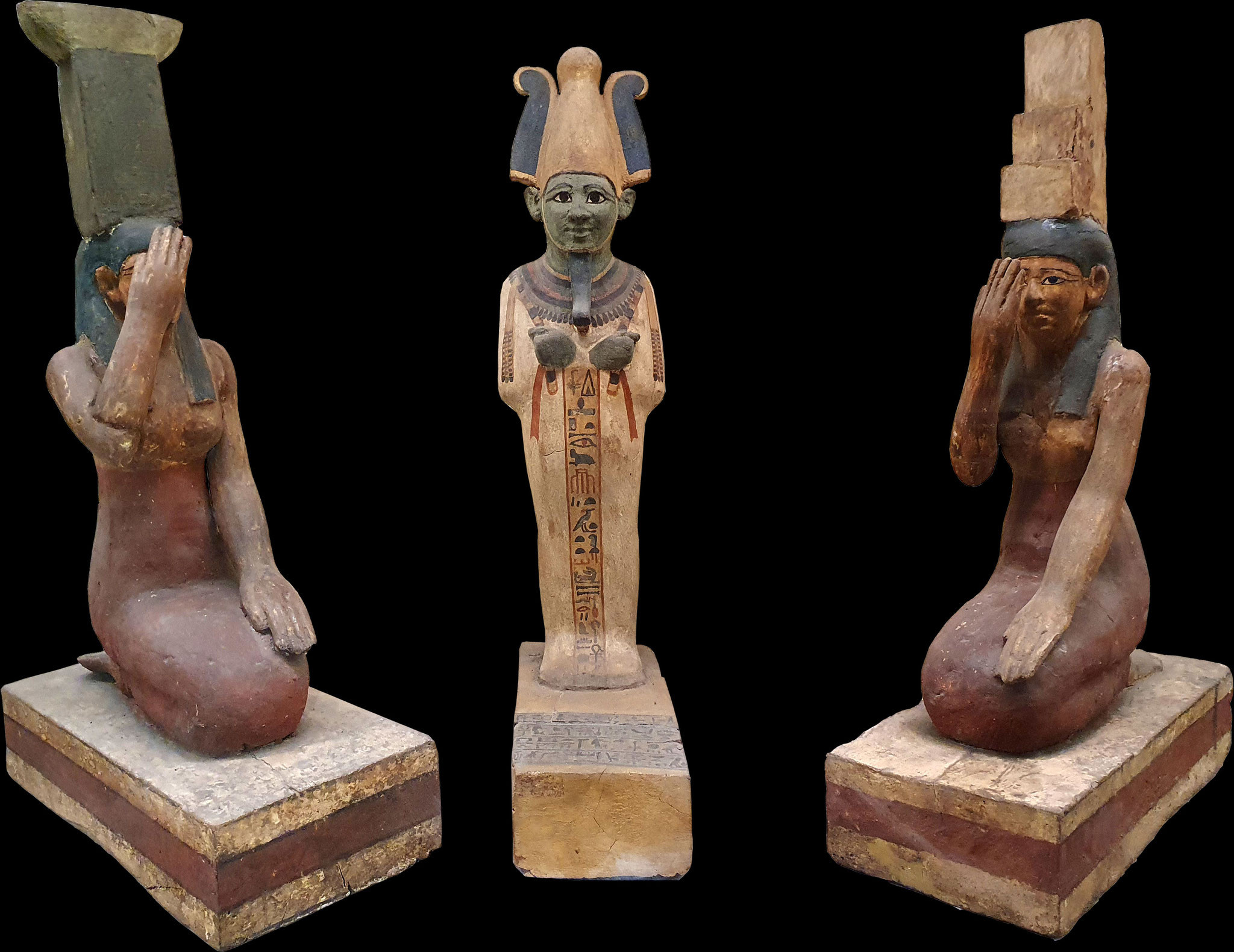
The gestures of mourners are stereotyped, primarily hands turned toward the face, placed above the head as a sign of affliction, or turned outward as a sign of communication with the deceased. If these gestures are those of common women, they are also those of deities such as Isis and Nephthys in the lamentation surrounding the body of Osiris. Sometimes tears are depicted.
Although they are called mourners — or male mourners, for men also weep — they do not only weep. They are also capable of declaiming or singing lamentations or elegies. They engage in a form of "total theater" in which they involve themselves physically and sonically.

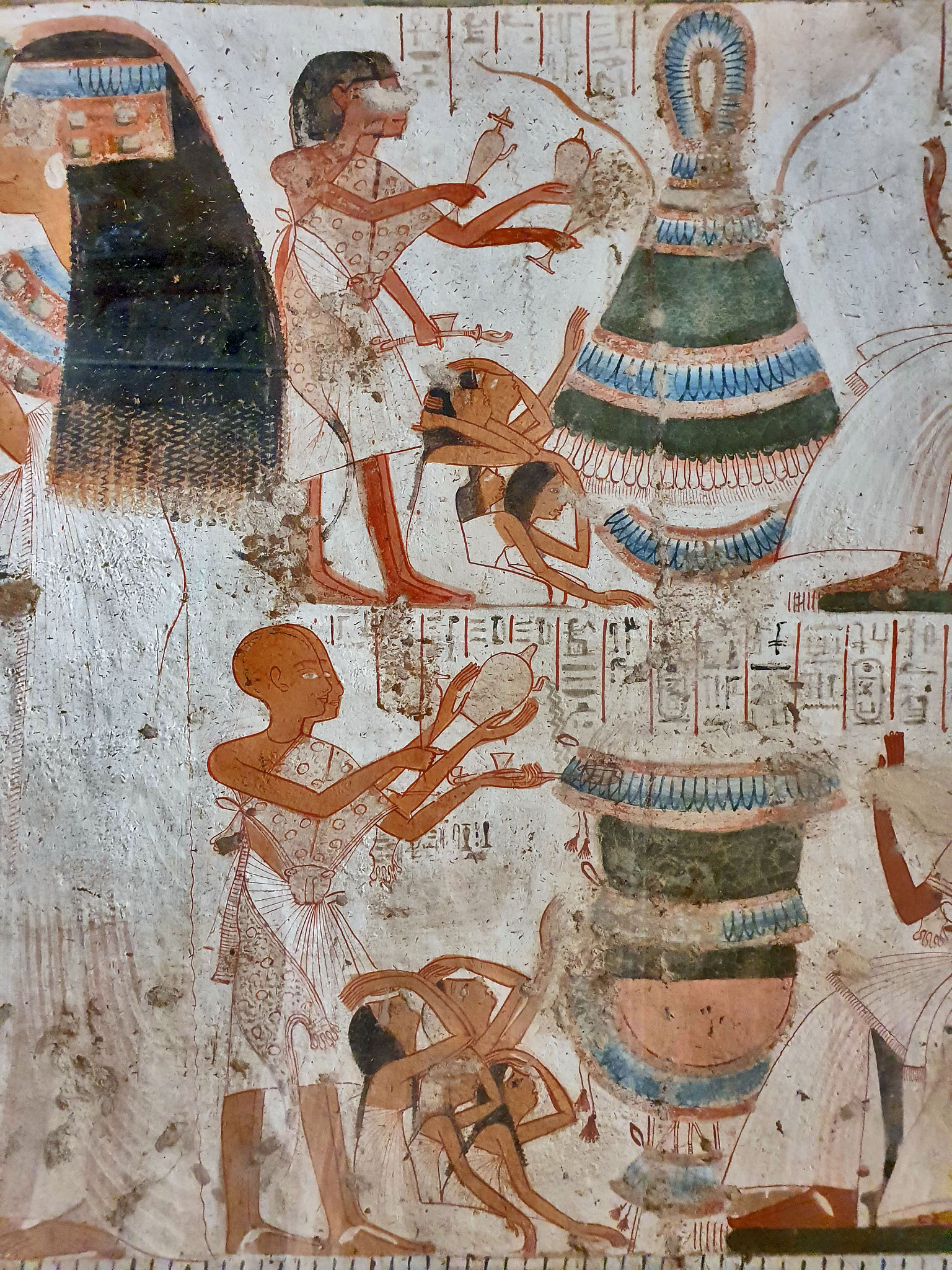


The tomb of Ramose

Pharaonic epigraphy offers many examples of funeral elegies. Here is one example:
"The house of those who are in the West is deep and dark.
It has neither door nor window,
No light to illuminate it,
No north wind to refresh the heart.
There, the sun does not rise.
They are asleep all the time,
For darkness extends into the day.
How healthy the deceased would be if he could breathe the air!"
The iconographic richness of the tomb of Ramose is due in particular to the high functions held by this figure; he bore titles that were administrative, judicial, and sacerdotal:
- Administrative: "Vizier, governor/mayor of the city, overseer of documents, overseer of works on the great monuments, administrator of Upper and Lower Egypt, mouth that gives satisfaction throughout the land, regent of the entire land."
- Judicial: "Judge, judge of the high court, mouth of Nekhen (Hierakonpolis), priest of justice, judge in the decision of matters, dispensing justice, rendering justice daily and presenting it to the palace of his lord, he who does good and hates evil."
- Sacerdotal: "Supervisor of priests of Upper and Lower Egypt, supervisor of the temples of all the gods, the greatest of seers, concerning the secrets of the sacred writings, chief of offerings to the gods, aware of the secrets of the two serpent goddesses, knowing the mysteries of all the gods, knowing the mysteries of the South On (Hermonthis/Ermant), knowing the secrets of the underworld, entering into the secrets of heaven and earth, sem-priest, directing all officials (lit. all šndyt-loincloths)."
Not mentioned are the honorary titles as well as titles related to royalty, bureaucracy, and the common people..[1]
________________
[1] According to Dr. Sigrid Hodel, Life and Death in Ancient Egypt.
The procession and the mourners
The funeral procession painted on the south wall of the tomb is divided into two parts: on the upper register, the funeral convoy; on the lower register, the bearers of the funerary goods and the mourners.
The number of mourners correlates with the exceptional size of the tomb and with the quantity of offerings transported to the tomb, a sign of the deceased's renown.

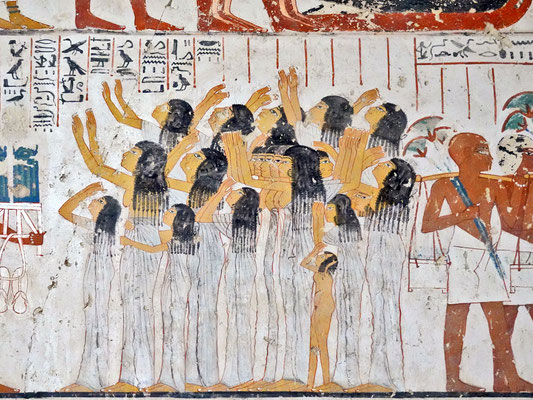
The mourners are divided into two groups. The first, in the direction of the march, includes ten professional mourners proper, eight crouching and two standing. Their hair is undone, and tears flow down their cheeks. The crouching women gather dust or mud and throw it onto their heads. The nine other women are not weeping, and their attitude is different. They may be singers of lamentations or funeral eulogies. Although these women express themselves vocally, their mouths are closed. Examples from other tombs show open mouths.

The second group of mourners is placed in the opposite direction of the march. The women are bare-breasted. They raise their heads and arms toward the sarcophagus placed on a barque and a sledge. They wear a long pleated garment fitted at the waist. Most of them are young. They are recognizable by their firm breasts. An older woman, perhaps the widow, is depicted with a drooping chest, which does not necessarily indicate advanced age, but rather that she has given birth and nursed her children. A weeping young girl clings to her. Again, all the women have their mouths closed and are weeping. In the foreground, a young child is depicted completely naked.
A total of 42 women are counted. Curiously, this number correlates with the number of nomes, that is, the provinces of Egypt. Now, it is known from the inscriptions in the tomb that Ramose was administrator and supervisor of the priests of Upper and Lower Egypt, that is, of the 42 nomes. Is this a simple coincidence?
Hieroglyphs provide some information about the procession, but they remain almost silent on the content of the lamentations, except for: "The great guardian has departed, he has passed by us."
One might wonder what the role of this weeping and lamentation is. While the natural expression of grief by the family and loved ones is undeniable, other objectives overlap: giving emphasis and pomp to the funeral is undoubtedly one of the most visible aspects. Through this total theater composed of gestural and sonic excesses, the mourners also seek to attract the attention of benevolent spiritual entities so that they may guide the deceased on his journey to the afterlife, the ultimate fantasized goal of all the living at that time.

The video capsule (in French)
Location & date: Egypt. Theban necropolis, Sheikh Abd el-Gournah. October 2022. Duration: 06:13. © Patrick Kersalé 2022-2026.
In ancient Egypt, mourners held a prominent place within funeral rituals, fulfilling a dual function: they embodied the grief of the deceased's relatives while also lending a solemn and spectacular dimension to the burial ceremonies.
The tomb of Ramose, a vizier from the 18th Dynasty, offers a remarkable illustration of this practice. Pictorial depictions reveal a meticulous organization of the mourners, divided into two distinct groups: one seems dedicated to lamentations and weeping, the other to the declamation or chanting of funeral elegies.
This funerary staging, characterized by heightened expressiveness in both gesture and sound, held a significance that went beyond mere displays of mourning. Indeed, this ostentatious demonstration also aimed to attract the attention of benevolent spiritual entities. In the Egyptian conception of the afterlife, these ritualized manifestations were perceived as a means of facilitating the deceased's journey to the world of the dead, the ultimate aspiration of earthly existence within the religious thought of ancient Egypt.