

Burkina Faso - Gan - Sacrificial Prayer
In the extreme southwest of Burkina Faso, at the heart of the Gan kingdom, prayer is not limited to words addressed to the invisible: it engages the body, the voice, the breath, the ancestors, and sacrifice. In this society where the bonds between the living and spiritual forces remain deeply rooted, sacrificial rites constitute acts of mediation aimed at maintaining the balance between humans, invisible powers, and the natural world.
This article offers an immersion into the practices of sacrificial prayer among the Gan, where songs, invocations, offerings, and ritual gestures form a complex symbolic language. Sacrifice appears here not merely as an offering, but as a mode of communication with the ancestors and spiritual entities that structure the social and cosmic order. Ritual speech, sound, and silence play a fundamental role, revealing a conception of the sacred based on relationship, memory, and the circulation of invisible forces.
Through these practices emerges an anthropology of prayer in which sonic vibration, the presence of the dead, and the sacrificial gesture all contribute to the same quest for harmony between the human and the world of the invisible.
Texts, photos, videos © Patrick Kersalé 1999-2026. Last updated: May 10, 2026.
The traditional religion of the Gan
The Gan are traditionally animists. The concepts and names of the spiritual entities presented here are those used by the Gan themselves.
The pantheon of spiritual entities
There are three families of spiritual entities (we have retained the terminology used by the Gan themselves when they speak in French): the kperegbeye genies, the sɩ̃mɑ̃ spirits, and the ancestors or ancestralized deceased thé're khãga. A distinction is also made between the non-ancestralized deceased thé're, who have the provisional status of ancestor but whose final funeral rites have not yet been celebrated and whose ancestralization has not yet been accomplished. Spirits and genies are not eternal, but can live for several centuries. According to belief, they have the same activities as humans but are more powerful because of the immense knowledge they have accumulated over the ages. The genies pass on their knowledge to humans who trust them; thus, to overcome their ignorance in many areas, humans turn to them for guidance in daily life: important decision-making, diagnosis and treatment of illness, detection of an enemy… These three types of spiritual entities communicate with one another and exchange information about the world of humans.
The genies
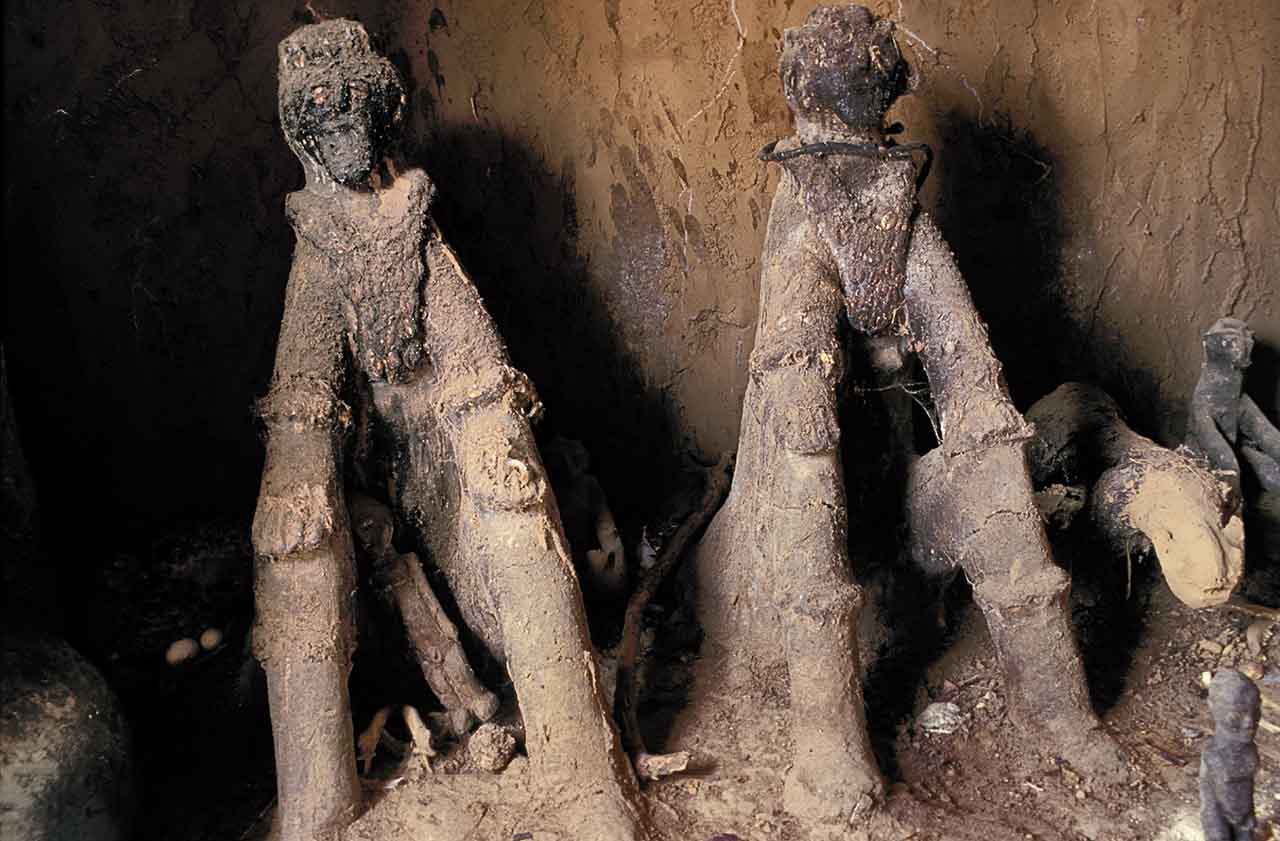
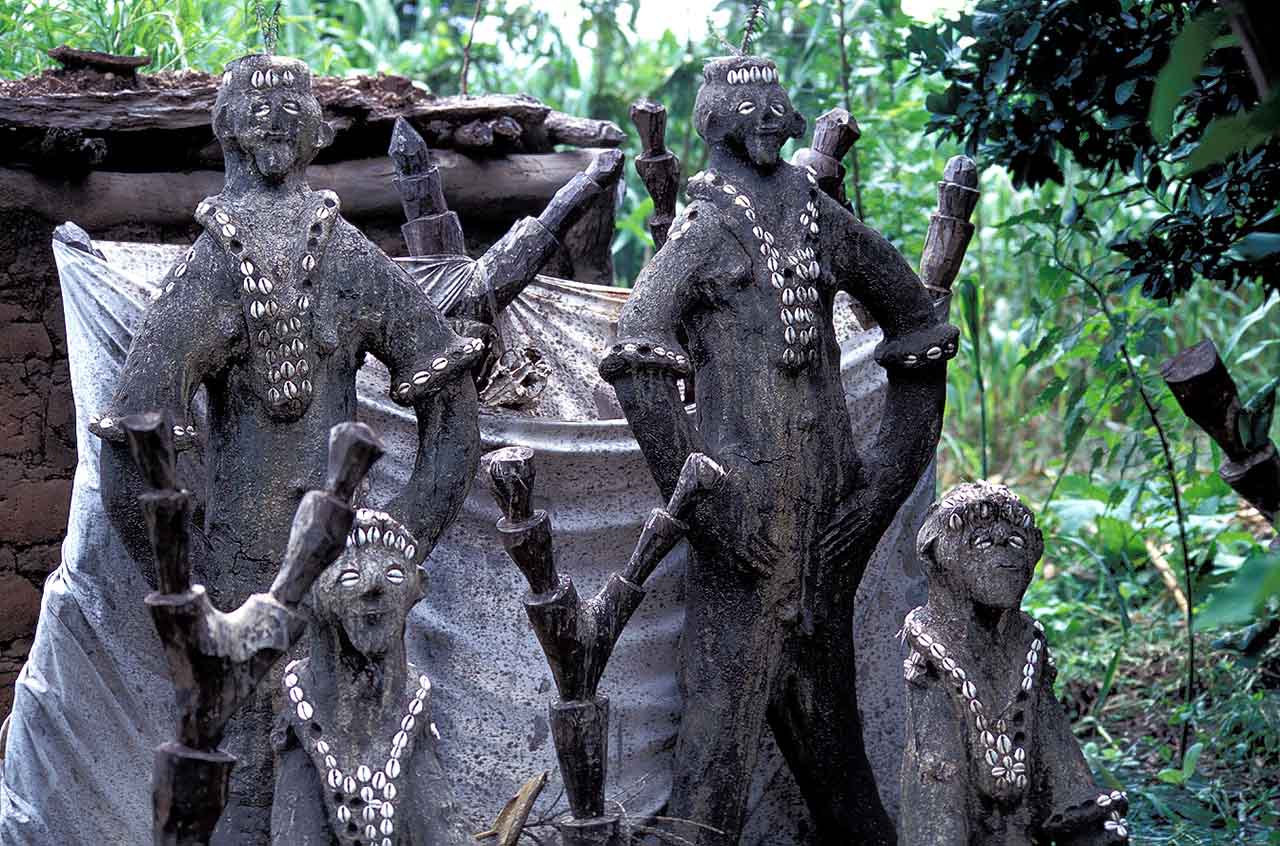
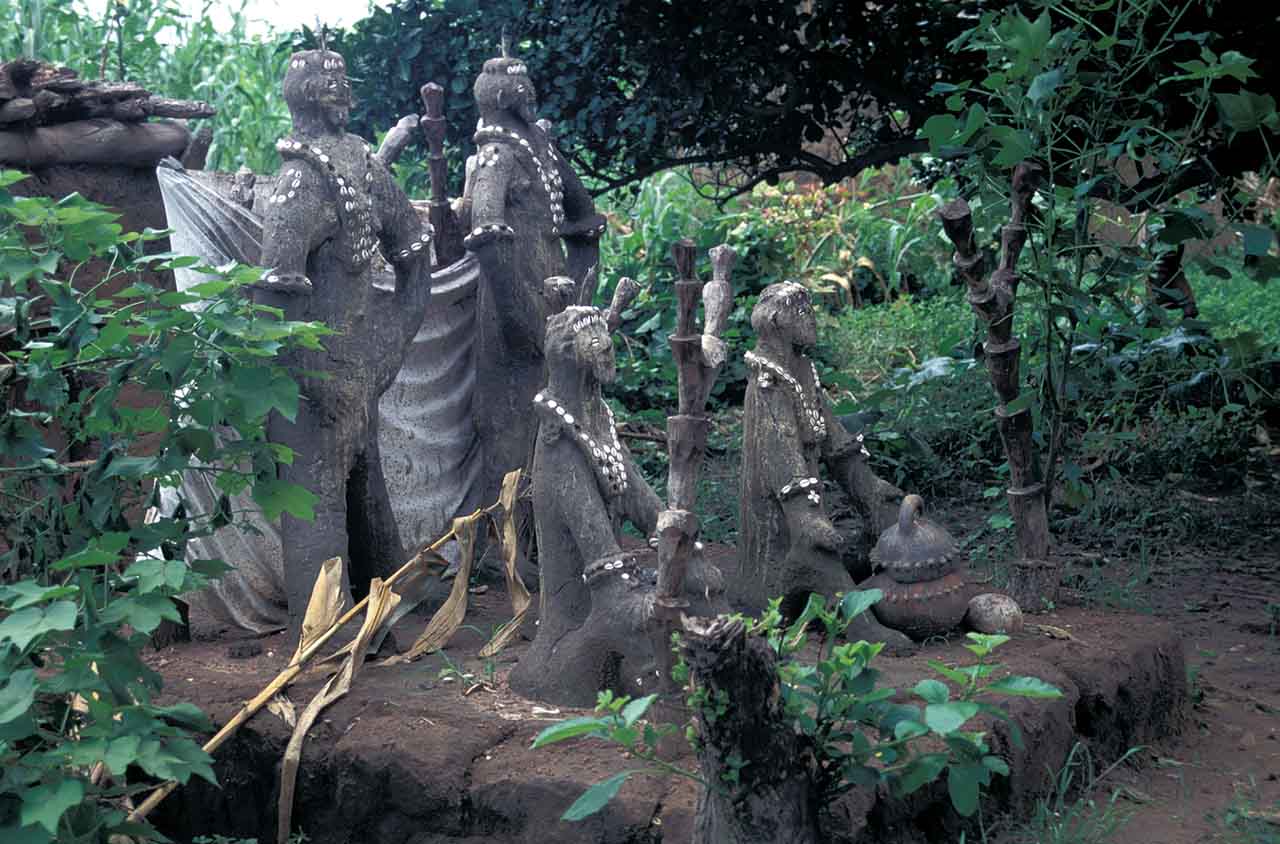
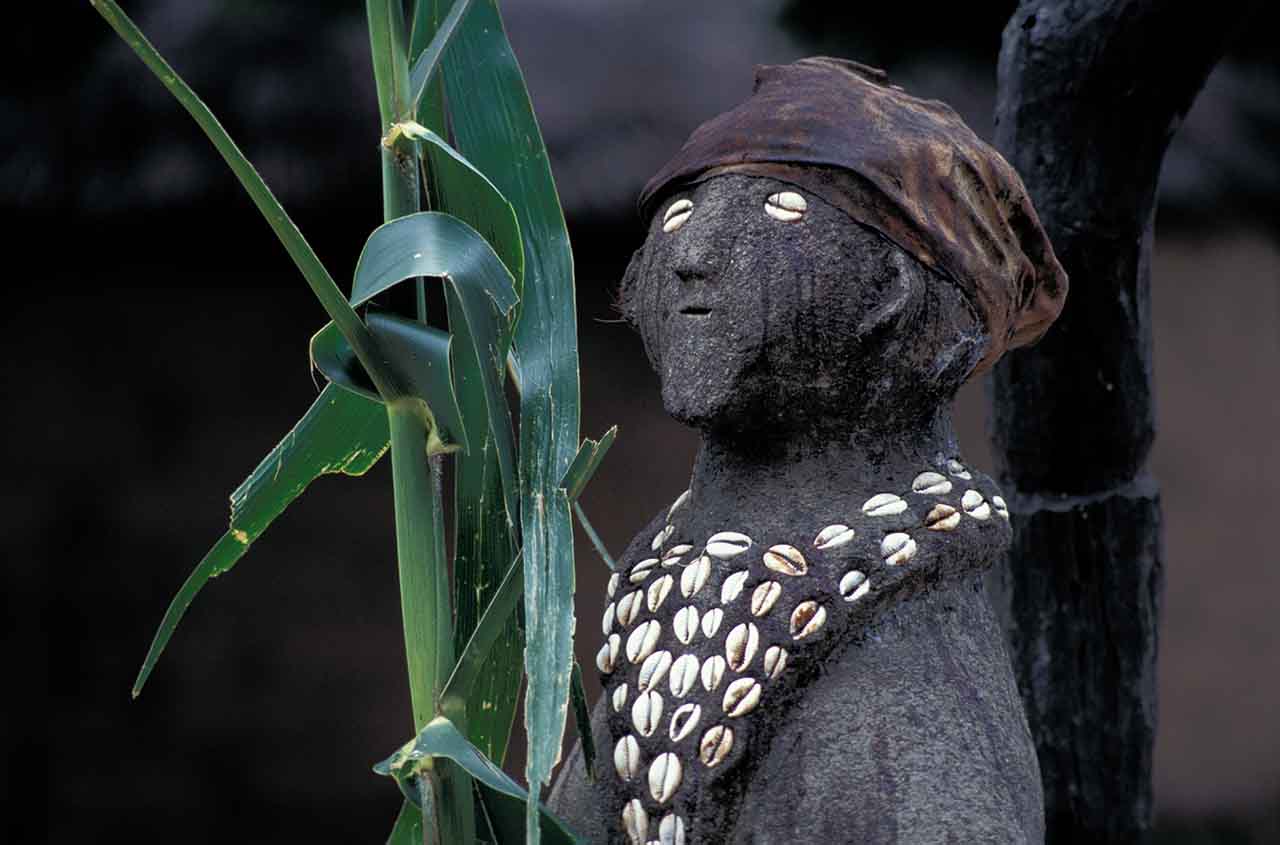


There are two types of genies: interior genies and exterior genies. The first are installed inside dwellings or in sɩ̃duko sanctuaries, while the second are placed in the open air in the courtyards of houses. Both types come to inhabit humans during specific initiations led by a master initiator, who also oversees the construction of their physical representation. If the initiator does not possess the technical skill to make them, he will have them built by a genie maker (sɩ̃ mɑgɑ).
Each genie is three-headed: a man-woman couple and a kponó 'ɩyɑ king. The importance of the genies is linked to the seniority of their initiation. The oldest initiates always hold the highest hierarchical status.
A complete initiation is represented by a couple of genies and a king. At the time of initiation, the couple is installed first. The king is only installed one to two years later in the courtyard of his owner’s house. In the meantime, the couple is placed under the tutelage of the initiator’s king, who resides in his own courtyard.
When a new couple of genies is initiated without a king, the already present king takes the new couple under his protection.
The number of three-headed entities installed in a courtyard is usually one or two per courtyard, although in the past there have been cases of an owner possessing as many as eight entities.
The spirits
There are three families of spirits:
- sɩ̃ nyɑɑmɑ (lit. “found spirit”): a spirit generally discovered during farming or hunting.
- sɩ̃ diyeeme (lit. “edible spirit”): a spirit acquired from another owner in exchange for cowries and/or animals.
- thɑmánɩ (lit. “to build the head”): the spirit that creates newborns and is responsible for the house. It is the primary protector of the family. Possessing this spirit requires strictly observing all its taboos. A sɩ̃ nyɑɑmɑ or sɩ̃ diyeeme spirit can also become a thɑmánɩ.
- The ancestors
There are two types of ancestors: the ancestralized (only men) and those who are not (which we will now call “non-ancestralized deceased”). We will focus particularly on the first group. Ancestralization takes place during the end of mourning (final funeral rites).
Ancestors are hierarchical spiritual entities, with the oldest considered the most important; the others follow in order of seniority. The number of generations of ancestors worshipped varies. The first on the list, called thĩ berige, is the founder of the original family that came from Ghana to the present-day Gan country.
Ancestors are protectors of the family. During a person’s lifetime, both paternal and maternal lines of ancestors are protective. At the time of ancestralization, the soul of the deceased joins the maternal lineage but is ancestralized in the paternal lineage. This ancestralization is represented by an altar (a small earthen mound) located in the house of the deceased’s first wife, or, if she predeceased him, in the house of his second wife, or, if he no longer has a wife, in the house of his son.
Context
In Burkina Faso, the Gan believe — like most animist peoples of West Africa — in one supreme God. To communicate with this higher entity, they use intermediaries that they refer to as spirits, genies, or ancestors, whether these are materialized or not. The material forms can include statuettes, stones or piles of pebbles, pottery, bundles of branches, and other objects. In French-speaking West Africa, such physical representations are known as “fétiches” (fetishes).
The sacrifice and the incantation that precedes it are always conducted by at least two people: “the one who leads the incantation” and “the one who follows the incantation. ”If the phrase consists of a single word, it is repeated by the follower; if it contains several words, only the last one is repeated. The virtue of this practice lies in the transmission of knowledge.
The chicken has a dual purpose: it serves both as a simple offering to the entity one wishes to honor and/or as a vector of communication between God and humans. One must not underestimate the value of a chicken for most Africans living in rural areas; it often represents a significant part of their patrimony, which frequently amounts to only a few hundred euros. Here we present a sacrificial prayer accompanying a sacrifice recommended by a diviner. It concerned a man who was trying to bring a project to fruition but kept failing. He then decided to consult a diviner to understand the cause of his setbacks. After consulting his spiritual entities, the diviner advised him to offer a chicken in sacrifice to a specific spirit so that it might help him with his project. In some cases, to solve the same problem, the response might have been more direct, more or less clearly identifying the person(s) or spiritual entity responsible. This prayer is addressed to a spirit, but it could equally be addressed — with the exception of the name of the invoked entity — to a genie or an ancestor.
The prayer is led by two diviners: the one leading the prayer appears in regular characters, while the one following, who repeats each word or the end of each phrase, appears in italics.
Location and date: Village of Obiré. December 1999.
Duration: 03:05. © Patrick Kersalé 1999-2026.
The Step-by-Step Sequence
00:00 – Geographical context of the event.
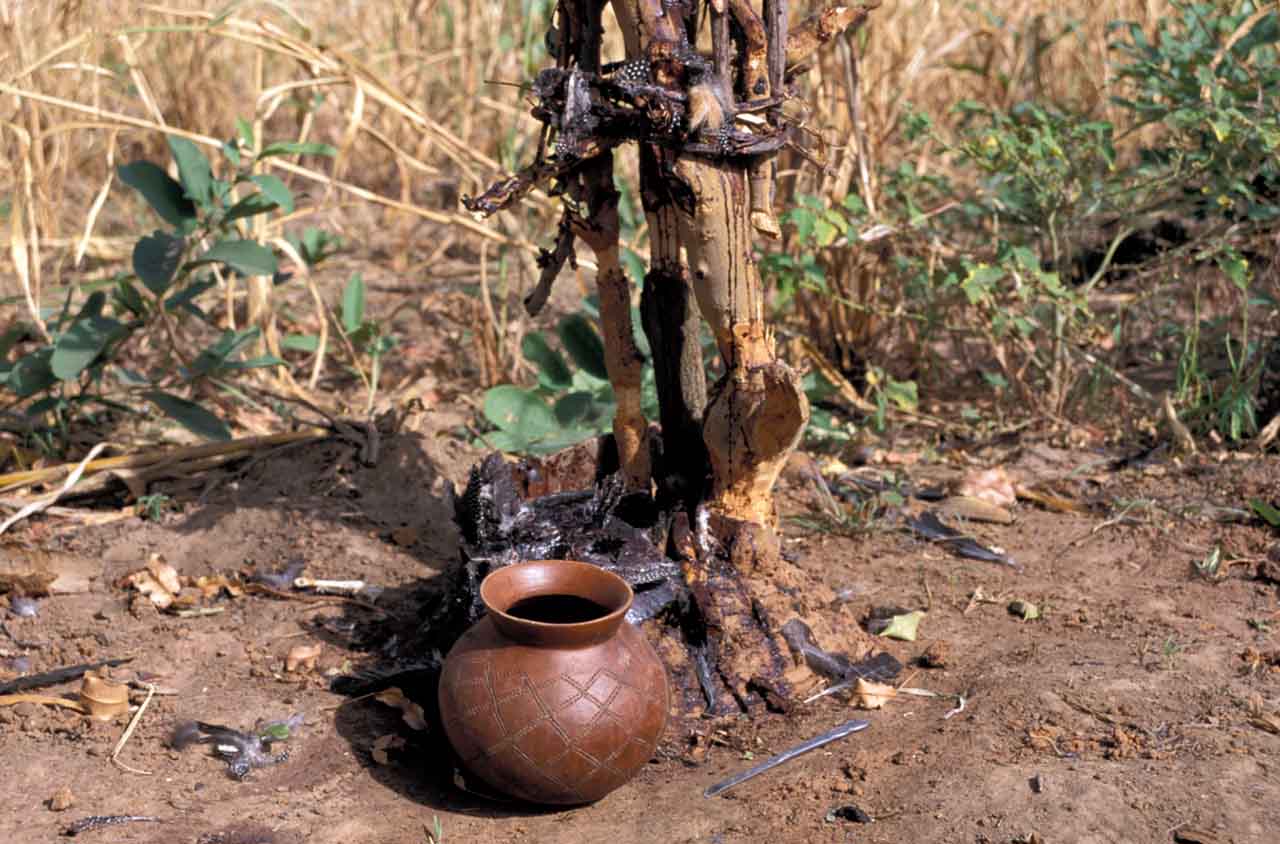
00:29 – Three men have come together for this sacrifice. The sponsor is the one holding the chicken. The spiritual entity is represented by branches planted in the ground. Cowrie shells are arranged in a line on the soil. Skulls of previously sacrificed animals and chicken feathers are attached to the branches. An introductory prayer is accompanied by an offering of white alcohol to the spiritual entity.
00:44 – The spiritual entity is awakened using an iron bell called keríge.
00:50 – “Supreme God, when I call upon God, I call upon the Father. I have called upon the Father. I call upon the ancestors. When I call upon the ancestors, I call upon the altar of the Earth, I call upon the spirit[1]. I have taken cowrie shells to consult the divination basket of hɛrkɛrɛ[2]. In the basket, you took the blade (of the knife) and gave me the sheath[3]. Attach the chicken’s feathers. If you see those who are trying today to damage my reputation, even though I have tried in vain to solve my problems, if this is the only cause, I will not discuss it further — take this chicken on its back[4].
The sacrificer slits the chicken’s throat and places it on the ground. The bird flaps its wings before expiring. It first stops on its side, then flaps its wings again before finally expiring on its side. (God has spoken through the bird, a symbol of innocence. The sponsor of the sacrifice therefore does not know the reason for his failure. He will need to continue investigating by consulting the spiritual entities again through the diviner. A more significant offering may be requested.)
__________
[1] The entity being invoked at this moment.
[2] A type of woven basket containing cowrie shells, used for divination. Here it is an attribute of the spiritual entity hɛrkɛrɛ, dedicated to the first wife of the first Gan king.
[3] Metaphor: “the blade represents the truth and the sheath what conceals this truth.”
[4] Meaning: “make the chicken expire on its back,” which signifies obtaining the truth. If the animal dies on its belly, it means the spirit refuses the request.
Prayer Organization
The prayer is led by a leader and a follower. The leader pronounces the words in regular font and the follower in italics.
« khɑyekire / wᴐnnɑ / nɑmɩyɩ / yɩ / yekire / yekire / mɩyɩ / mɩyɩ / siI / siI / mɩyɩsɑ / yɩsɑ / siI / siI / mɩyɩ / yɩ / khɑ̃gɩbɑ / khɑ̃gɩbɑ / nɑmɩyɩsɑ / yɩsɑ / khɑ̃gɩbɑ / khɑ̃gɩbɑ / mɩyɩ / yɩ / sɩrgɑ / sɩrgɑ / mɩyɩ / yɩ / mʋsɩ̃mɑ / sɩ̃mɑ / mɩkhoro / khoro / kheere / kheere / ɩ̃yoo / yó / hɛrkɛrɛ / hɛrkɛrɛ / wá / wá / kpᴐmbɩbʋ / kpᴐmbɩ / mʋkhoro / khoro / biInɑ / biInɑ / yɛhɑ̃ɑmɩ / hɑ̃ɑmɩ / the'nɛ / the'nɛ / sũdoogɩrɑ / doogɩrɑ / mɑɑgɩ / mɑɑgɩ / yɛná / ná / khɑ'mʋnɩ / khɑ'mʋnɩ / mʋnyɑtᴐᴐwɑ' / tᴐᴐwɑ' / de / de / pɩ̃ɩnɑ / pɩ̃ɩnɑ / horo'ri / horo'ri / nánɑmɑ / nɑmɑ / ɩ̃khɑbɑ / khɑbɑ / mʋná / mʋná / bɑbu' / bu' / nyisige / nyisige / tɩrɑ / tɩrɑ / deeri / deeri / sɑ̃gɑ / sɑ̃gɑ / fɛɛrɑ / fɛɛrɑ / mʋ / mʋ / kᴐ' / kᴐ' / mʋ / mʋ / mɩɩnyɩnɑ / mɩɩnyɩnɑ / yɛɛ / yɛɛ / - / kpũne / kpũne / ná / ná / tɩrɛ / tɩrɛ / deeri / deeri / sɑ̃gɩrɑ / sɑ̃gɩrɑ / mɩ / mɩ / thɩɩwɑ' / thɩɩwɑ' / ɑkhɛmɑ / khɛmɑ / sũminɑ / sũminɑ / pɑ̃ɑnᴐ » / kóko »
"God / supreme / if I call / call / God / God / I call / I call / the father / father / I called / called / the father / father / I call / call / the ancestors / ancestors / if I call / I call / the ancestors / ancestors / I call / call / the altar of the earth / altar of the earth / I call / call / the altar of the earth / altar of the earth / I call / call / the spirit / spirit / I took / took / cowrie shells / cowrie shells / I went / went / into the divination basket / the divination basket / to / to / into the basket / basket / you took (inside) / took / the blade (of the knife) / blade / and gave me / gave me / the sheath / sheath / the chicken feathers / feathers / stick the chicken feathers / stick the chicken feathers / if you / if / you say / say / you saw nothing / saw nothing / that / that / the enemy / enemy / ran / ran / arrived / arrived / he said / said / you / you / will have / will have / a name / name / of what / what / caused / caused / today / today / you / you / catch / catch / your / your / things (problems) / things / (marks the past) / - / in vain / in vain / it is / it is / this / this / that caused / that caused /the cause /cause/I / I / will not chatter much / will not chatter much / we take / take / chicken / chicken / on the back" / the back"