
What the West Believes to Be Universal Is Not – An Investigation into the Techniques of Entering into Relationship with the Invisible
© Florence de Kervadec 2026
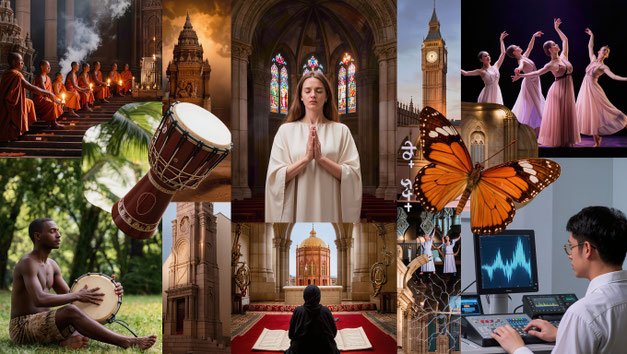
It is endlessly repeated that prayer is universal, as old as humanity itself. Yet when one observes what people do with their bodies, their breath, their voices, or their silence, this certainty begins to crack. Behind the word "prayer," forged by Christianity, lies a diversity of practices that the Western model of addressing a distant God fails to capture.
What if the Word "Prayer" Was Already Telling You a Story?
Question: Do you think you know what it means "to pray"? The answer lies first in etymology.
Latin precari ("to ask, entreat") and Russian molitva ("appeal, invocation") reflect a vertical relationship to a transcendent god. But Arabic ṣalāh designates a codified practice of recitations and prostrations. Mongolian khural refers to a ritual assembly. Among the Maya, jach t'aan ("true word" in Lacandon) evokes a cosmic efficacy. Navajo hózhó (phonetic [ˈhoʒṍ]) speaks of harmony, while Quechua Pachamama suggests a reciprocity with a living cosmos.
What this reveals: The word "prayer" already carries a Western vision — an individual addressing a transcendent power.
Do You Think Silence is Always a State of Contemplation?
Question: Do you think that being silent necessarily means turning toward God? Not so sure.
Among Siberian shamans, remaining silent would be ineffective: it is speech that acts (healing, chasing away, warding off). In this ritual world, silence is far from pure; it is ineffective. Among the Buryats, silence is a posture of lying in wait to hear a sign or to deceive spirits. Among the Inuit, it is a restraint so as not to disturb the balance. In Buddhist zazen, silence works on the body and consciousness, not on a dialogue with God.
What this shifts: Silence has no universal meaning. What is universal, however, is that human beings everywhere make it a practice embedded in a cultural and symbolic context: to contemplate, to listen, to sharpen one's senses, to discipline one's body, and so on.
Ritual Speech: To Lose It or Master It?
Question: Do you think praying means saying words with conviction? Ethnography shows two opposing logics, both equally effective.
On one hand, surrender: glossolalia (speaking in tongues) among the Urapmin (Papua New Guinea) – prayer works when the speaker loses control and pronounces words they do not understand. On the other hand, extreme precision: Vedic mantras (accuracy of sound and rhythm), Shinto norito (codified intonation), Orthodox liturgy (linked gestures and recitations), the Jewish recitation of the Amidah (posture, orientation, order of blessings) – a single mistake can force a complete restart.
What this teaches us: Praying is not merely about "believing." Efficacy takes precedence, whether through surrender or through rigor.
What if Praying Meant Vibrating, Dancing, Embodying?
Question: Can you imagine a prayer without words, without explicit request, sometimes even without a god? Yet many traditions practice it.
- Balinese Kecak: hundreds of men sit in a circle and chant "tchak-tchak-tchak" in a continuous pulsation, without instruments. No verbal address, but this vocal mass produces a sonic saturation that participants experience as prayer. The repeated rhythm dissolves individual boundaries, transforming the group into a single sonic entity.
- In Theyyam (Kerala), after days of preparation (fasting, makeup, drumming, torch spinning), certain men embody the deity. They do not represent a god: they *are* the deity, blessing, arbitrating, answering. The faithful address themselves to a tangible presence, not to an image.
- Among the Yolngu of Australia, ritual body painting makes ancestors present on the participants' very skin. The body becomes a support for cosmological memory. The whirling dervishes, through continuous rotation, the breath of the reed flute, and the repetition of the name of Allah, alter their perception: prayer becomes a sensory state.
What this shifts: Prayer can be a metamorphosis of the body — collective vibration, incarnation, trance — rather than discourse addressed to an elsewhere.
To Ask or to Transform?
Question: Do you think praying means asking for something from someone? This Western conception of supplication is not universal.
- Among the Yoruba (Nigeria/Benin), àṣẹ activates a cosmic force: healing, protection, fertility depend on the integration of gestures, offerings, and words.
- Among the Lakota, the vision quest (fasting, solitude, cold, exposure to the elements) engages the body in an ordeal to obtain personal power.
- Among the Hopi, kachina dances (masked dancers embodying natural forces) act through choreography as much as through words — to bring rain, to ensure fertility.
- Among the Aboriginal peoples of Australia, songlines (dreaming tracks) reenact the journeys of the ancestors and maintain the balance of the world.
- Among the Toraja (Sulawesi, Indonesia), the great funerals (processions, buffalo sacrifices, circulation of relatives) do not merely accompany the deceased: they restore social order and redistribute vital forces.
Finally, in shamanic practices, the shaman travels, dances, falls into trance, and modifies his breathing — he transforms himself in order to act (to heal, to accompany the dead, to ensure prosperity).
What this reveals: Ritual aims less at communicating with a transcendent power than at transforming a state, a balance, or a relationship.
Ritual Space: A Place Born from Gesture
Question: Do you think prayer necessarily requires a sacred place already separated from the ordinary world? Here again, practices tell a different story.
In Breton pardons, processions, songs, and banners temporarily transform paths, chapels, and villages. The territory becomes a ritual space through the collective circulation of bodies, sacred objects, and prayers. Conversely, on the trails of the Kumano Kodō in Japan, the pilgrim often walks alone, short of breath on long climbs over wet stones beneath the thick mountain mists. While the Breton pardon is a crowd and a procession, the Kumano Kodō is silence and inhabited solitude. Yet the traces left by other pilgrims and the diffuse presence of the kami suffice to transform the landscape itself into a ritual space.
What this shifts: A sacred place does not exist independently of the ritual practices and movements that make it operational.
Conclusion: Shifting the Gaze
What the West gathers under the word "prayer" covers very different realities: transforming a relationship, making a presence perceptible, altering a state of the body, maintaining a cosmic balance.
Let us reverse the question. The problem is no longer whether prayer exists everywhere, but rather to ask the West: why has it so often interpreted vastly different practices through its own single model, to the point of turning it into a universal interpretive grid?
What if the word "prayer" ultimately revealed less a universal reality than a very Western, historical, and religious way of inhabiting the world? A way of separating the visible from the invisible, speech from gesture, the human from the cosmos, and of conceiving the divine as an external presence to be addressed rather than as a presence circulating among bodies, places, and the rhythms of the world.
Anthropology might then gain by observing what humans actually do: singing into trance, painting a body to bring ancestors back, spinning until their perception changes, keeping silent in expectation of a sign, or walking for days toward a place made sacred by the gestures themselves.
Écrire commentaire